Why it matters here
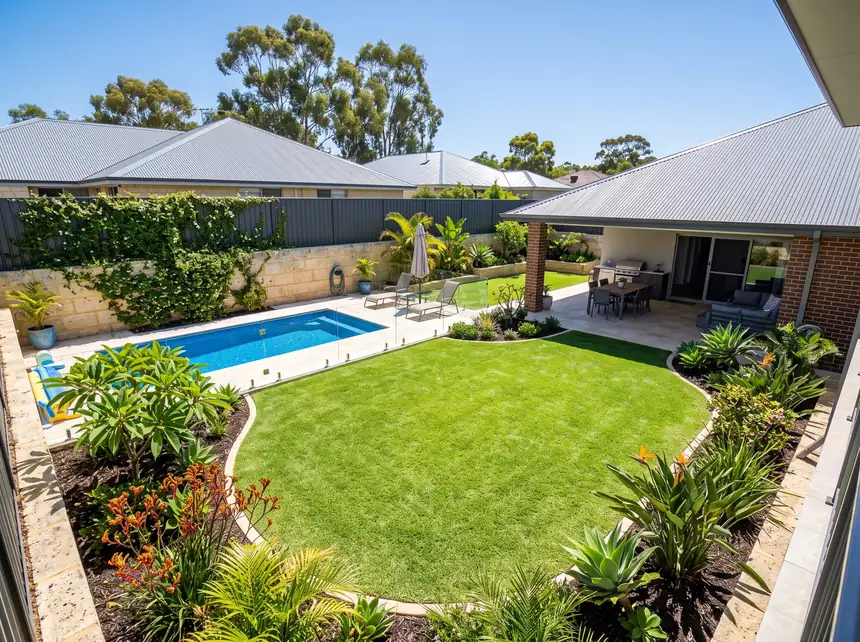
Around 36% of Perth and Peel's drinking water goes onto gardens. Meanwhile the Peel-Harvey estuary — twice the size of Sydney Harbour and a Ramsar wetland — needs its phosphorus load cut by 59% to stay healthy, and nutrients leaching through sandy soils from gardens and lawns are part of the problem. Waterwise gardening fixes both at once.
Step 1: fix the sand
Water Corporation's first step is improving sandy soil with clay and compost. Mandurah sand goes water-repellent when dry — water runs off the surface instead of soaking in. Work bentonite or a clay-based amendment and compost through the top 30 cm of garden beds (10 cm under lawn), and apply a soil wetter each spring.
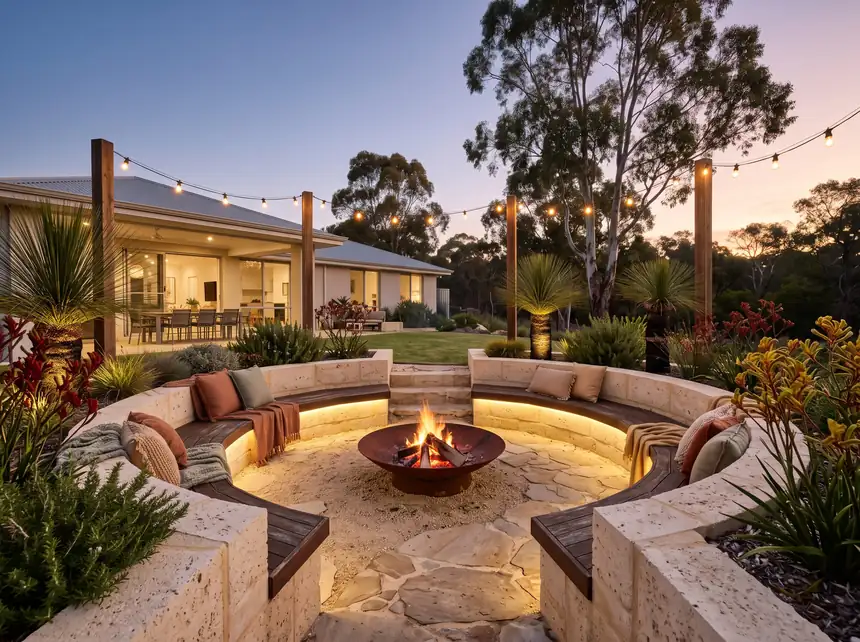
Alfresco fire pit zone with limestone seating walls built by Mandurah Landscaping
Step 2: hydrozone
Put thirsty plants together, tough plants together, and give each group its own retic station. Lawn, garden beds and pots should never share a station. Drip in the beds, pop-ups on the lawn.
Step 3: choose plants that belong here
Coastal natives: Westringia, cushion bush, coastal daisy, kangaroo paw, grevilleas, banksias, lomandra, dianella. Waterwise exotics: agave, aloe, olives, frangipani, rosemary, lavender, ornamental grasses. Screening: dwarf lilly pilly, pittosporum, callistemon. Avoid: hydrangeas, azaleas, most ferns and anything from a Melbourne nursery catalogue.
Step 4: mulch deep
Five to ten centimetres of coarse, chunky mulch (not fine stuff that mats) cuts evaporation dramatically and keeps roots cool. Top it up every spring. Keep it off plant stems.
Step 5: fertilise low-P, twice a year
Use a low-phosphorus lawn and garden fertiliser (N:P:K around 10:1:6), at 12 g/m² or less for buffalo and kikuyu lawns, only in September–November and March–April. Never before heavy rain. Most of the phosphorus in a high-P fertiliser washes through sand into the groundwater and then the estuary — it isn't feeding your plants anyway.
The verge
The City of Mandurah's waterwise verge guide: amend the top 30 cm, 5–7 cm of coarse mulch, prostrate groundcovers near the kerb, finished 7.5 cm below the kerb, no loose gravel, and hardstand (including synthetic turf) capped at 50%. An unirrigated native verge costs little and never gets a watering fine.
Quick answers
Do waterwise gardens look sparse?
Can I still have lawn?
What's a soil wetter?
Related services
Price ranges are Perth–Mandurah market guides at the time of writing, not quotes. Rules summarised from Water Corporation, WA Building Regulations 2012 and council guidance — confirm with your council.